
 By BitradeX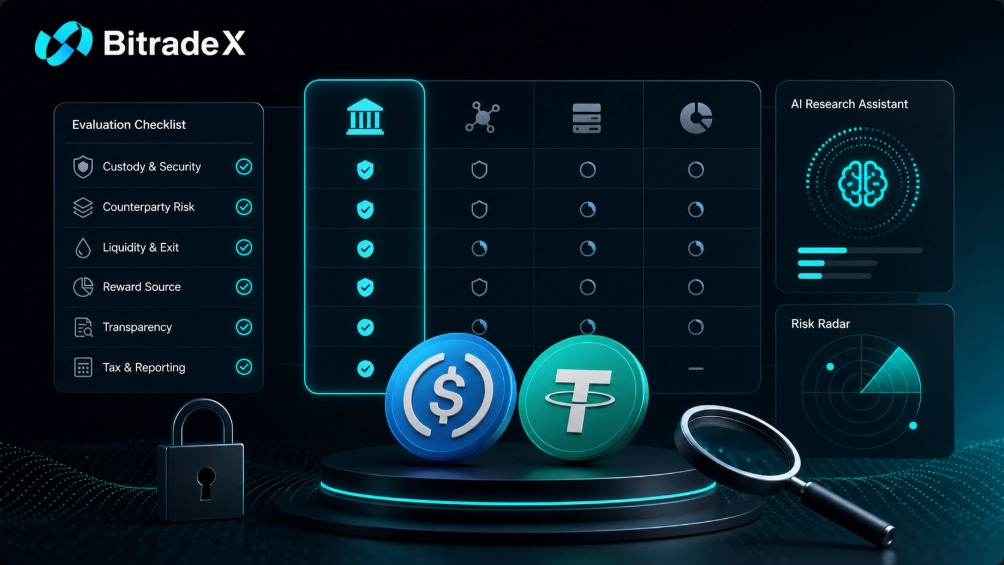
The search for the best place to earn interest on stablecoins in 2026 usually starts with a table. USDC here, USDT there, flexible terms, locked terms, a few percentages, and a button. That is the wrong first screen.
Stablecoins reduce one kind of risk: direct exposure to a volatile coin price. They do not remove platform risk, smart contract risk, reserve risk, regulatory risk, tax reporting, liquidity delays, or the possibility that the reward source changes. A stablecoin interest product can look calm because the unit is pegged to a dollar while the actual risk sits somewhere else.
The defensible claim is this: the best stablecoin interest venue in 2026 is not the one with the most attractive displayed rate; it is the one where a user can explain exactly who holds the stablecoin, what creates the reward, when money can leave, and what fails first.
A Stablecoin Is Not an Interest Product by Itself
The SEC Division of Corporation Finance’s April 4, 2025 Statement on Stablecoins described certain covered stablecoins as crypto assets designed to maintain a one-for-one value relative to USD, backed by low-risk and readily liquid reserves. The same statement also describes covered stablecoins as payment or store-of-value instruments, not investments that entitle holders to interest, profit, or other returns.
That distinction matters. If a user earns something on a stablecoin, the reward usually comes from an added arrangement: exchange rewards, lending, DeFi lending, liquidity provision, a token incentive program, or a managed product. The stablecoin is the asset. The interest product is the arrangement wrapped around it.
So the first filter is simple: do not ask which stablecoin pays the most. Ask who is paying, why they can pay, and what claim the user receives in return.
The 2026 Regulatory Line Is Sharper
The GENIUS Act became Public Law No. 119-27 on July 18, 2025, according to Congress.gov. The statute created a federal framework for payment stablecoins, including issuer rules, reserve requirements, redemption policy disclosure, and monthly reserve detail publication. It also changed the way U.S. readers should think about “stablecoin interest.”
Payment-stablecoin regulation is not the same as interest-account safety. A law can improve reserve and issuer standards for payment stablecoins while leaving separate reward programs to be evaluated on their own facts. An issuer-backed payment token and a platform reward program are not the same object.
That is why the phrase “earn interest on stablecoins” needs to be split into two questions: is the stablecoin itself transparent and redeemable, and is the interest venue using the stablecoin in a way the user understands? A strong answer to the first question does not automatically solve the second.
The Venues Are Different Businesses
The market in 2026 has four broad venue types. They should not be ranked on one line.
| Venue type | What creates the reward | What to inspect first | Main failure mode |
|---|---|---|---|
| Exchange reward program | Platform economics, partner programs, or lending demand | Terms, eligibility, region, custody, withdrawal rights | Program changes or platform liquidity |
| Centralized lending desk | Borrower demand and lending spread | Borrower quality, collateral policy, legal claim, audits | Counterparty default or platform failure |
| DeFi lending protocol | On-chain borrowing demand | Utilization, collateral assets, liquidation rules, oracle design | Smart contract, oracle, or liquidation stress |
| Stablecoin liquidity pool | Trading fees and incentives | Pool depth, assets in the pool, peg history, impermanent loss | Depeg, pool imbalance, contract exploit |
The table is deliberately not a ranking. It is a map of business models. A lower rate in a more understandable structure may fit a cautious user better than a higher-looking rate whose mechanics are vague. A DeFi-native user may prefer transparent on-chain mechanics but still accept contract and oracle risk. A beginner may prefer a simpler interface, but simplicity can hide custody and lending exposure.
The Rate Should Be Compared Against Its Source
A stablecoin reward rate is not self-explanatory. It is a price for risk, liquidity, demand, marketing, or complexity.
If the reward comes from lending, the rate reflects demand from borrowers and the venue’s credit assumptions. If it comes from DeFi lending, it may move with utilization: when more borrowers draw from a pool, the rate can rise; when utilization falls, it can compress. If it comes from a liquidity pool, the rate may combine trading fees with token incentives that can change or decay. If it comes from a platform campaign, the rate may be temporary.
This is why a “best place” article that ranks only by percentage is incomplete. The percentage is the symptom. The source is the diagnosis.
The Risk That Does Not Show Up in the Peg
Stablecoin users often focus on whether the coin holds one dollar. That is necessary, but not sufficient.
The SEC’s Investor.gov bulletin on crypto asset interest-bearing accounts warns that these products are not the same as bank or credit union deposits and may lack the same protections. It also notes that deposited crypto assets may be used in lending programs or other activities, exposing users to the risks of those activities.
For stablecoins, that means a product can maintain its peg while the venue still creates risk. The platform can fail. Borrowers can default. A smart contract can break. A withdrawal queue can slow. A stablecoin can lose liquidity on secondary markets even if redemption is theoretically available to certain participants. A tax obligation can arise from rewards even when the user has not converted anything to dollars.
The IRS digital asset income page, last reviewed or updated on April 1, 2026, lists stablecoins and rewards income from staking or earn programs among digital asset income examples. That makes recordkeeping part of the venue decision. If a product cannot provide clear reward history, transfer records, and transaction exports, the rate is not the only cost.
A Practical Decision Rule
Use a four-layer filter before comparing rates.
First, filter by access and legality. Is the product available where the user lives, under terms the user can actually accept? Does the venue disclose eligibility, restrictions, fees, and withdrawal rules?
Second, filter by stablecoin quality. Is the stablecoin’s reserve model understandable? Who can redeem directly? Are reserve disclosures current? Does the stablecoin have deep liquidity across venues?
Third, filter by reward source. A user should be able to write one sentence: “This venue pays because…” If the sentence ends with “I do not know,” the product is not ready for comparison.
Fourth, filter by exit. How fast can the user leave under normal conditions, and what happens under stress? Flexible access, daily rewards, and app-based withdrawals are interface claims. The exit mechanism is the product.
Only then does the displayed rate deserve attention.
The Shortlist Test
A venue belongs on a serious shortlist only if it can answer these questions without forcing the user into guesswork.
| Question | Strong answer | Weak answer |
|---|---|---|
| Who controls the stablecoin? | Custody and legal claim are clear | “Your assets stay safe with us” |
| Why is the venue paying? | Lending, fees, incentives, or protocol mechanics are identified | “Put your stablecoins to work” |
| Can the rate change? | The terms describe when and how it changes | The rate is shown without conditions |
| How do withdrawals work? | Timing, limits, and pause rights are explicit | “Flexible” without mechanics |
| What records are available? | Reward history and exports are accessible | Tax records require manual reconstruction |
| What is the failure case? | Platform, protocol, depeg, or borrower risk is named | A generic risk paragraph |
The best venue for one user may be a poor fit for another. A trader who needs fast collateral mobility may care more about liquidity and platform integration. A DeFi user may prioritize on-chain transparency. A cautious long-term holder may prefer lower complexity and clearer records. “Best” only has meaning after the use case is defined.
Stablecoin Research Is Still Market Research
Stablecoins are designed to track a reference value, but stablecoin interest is connected to broader crypto market conditions. Lending demand, collateral stress, exchange liquidity, stablecoin supply, and risk appetite can all change the available reward.
Before choosing a venue, a user can monitor market conditions through a real-time crypto market view and compare whether a reward opportunity is appearing during calm conditions or during stress. The goal is not prediction. It is context.
A user who wants a more structured workflow can register through an AI-assisted digital asset platform and keep the stablecoin-interest decision separate from platform access. BitradeX can support market review and research organization, but it should not be treated as a stablecoin interest account or as evidence that rewards will be available. Digital asset trading involves substantial risk, and past performance does not determine future results.
The Practical Answer
The best place to earn interest on stablecoins in 2026 is the place where the user’s use case, legal access, stablecoin choice, reward source, custody model, exit path, and tax records all make sense together.
That answer is less satisfying than a ranked list, but it is more useful. A rate table can become outdated quickly. A decision framework stays useful because it forces the user to ask what the rate is paying for.
If a venue cannot explain why it pays, who holds the asset, when withdrawals can happen, and what breaks first, it does not belong at the top of the list, no matter how attractive the number looks.
FAQ
What is the best place to earn interest on stablecoins in 2026?
There is no single best venue for every user. A better approach is to choose only after checking legal access, custody terms, stablecoin quality, reward source, withdrawal rules, fees, records, and the venue’s main failure mode.
Do stablecoins themselves pay interest?
Usually no. A stablecoin is normally a payment or store-of-value token. Interest or rewards typically come from a separate arrangement such as lending, exchange rewards, DeFi lending, liquidity provision, or a promotional program.
Are stablecoin interest accounts like bank savings accounts?
No. Crypto interest products may lack the same protections as bank or credit union deposits, and deposited assets may be used in lending or other activities. Users should read the account terms and risk disclosures carefully.
Which is safer: centralized stablecoin rewards or DeFi lending?
Neither is automatically safer. Centralized programs require trust in custody, terms, platform liquidity, and legal claims. DeFi lending can provide on-chain transparency but introduces smart contract, oracle, liquidation, and wallet-operation risk.
How can BitradeX help with stablecoin interest research?
BitradeX can support market monitoring and AI-assisted research workflows before users evaluate stablecoin interest venues. It should not be treated as a stablecoin interest account or as a substitute for personal financial, tax, or legal advice.
Disclaimer
Digital asset prices can be volatile. This article is for informational purposes only and should not be treated as investment, legal, tax, or financial advice. Users are responsible for their own trading decisions and should evaluate whether any product or transaction is appropriate for their circumstances.