
 By BitradeX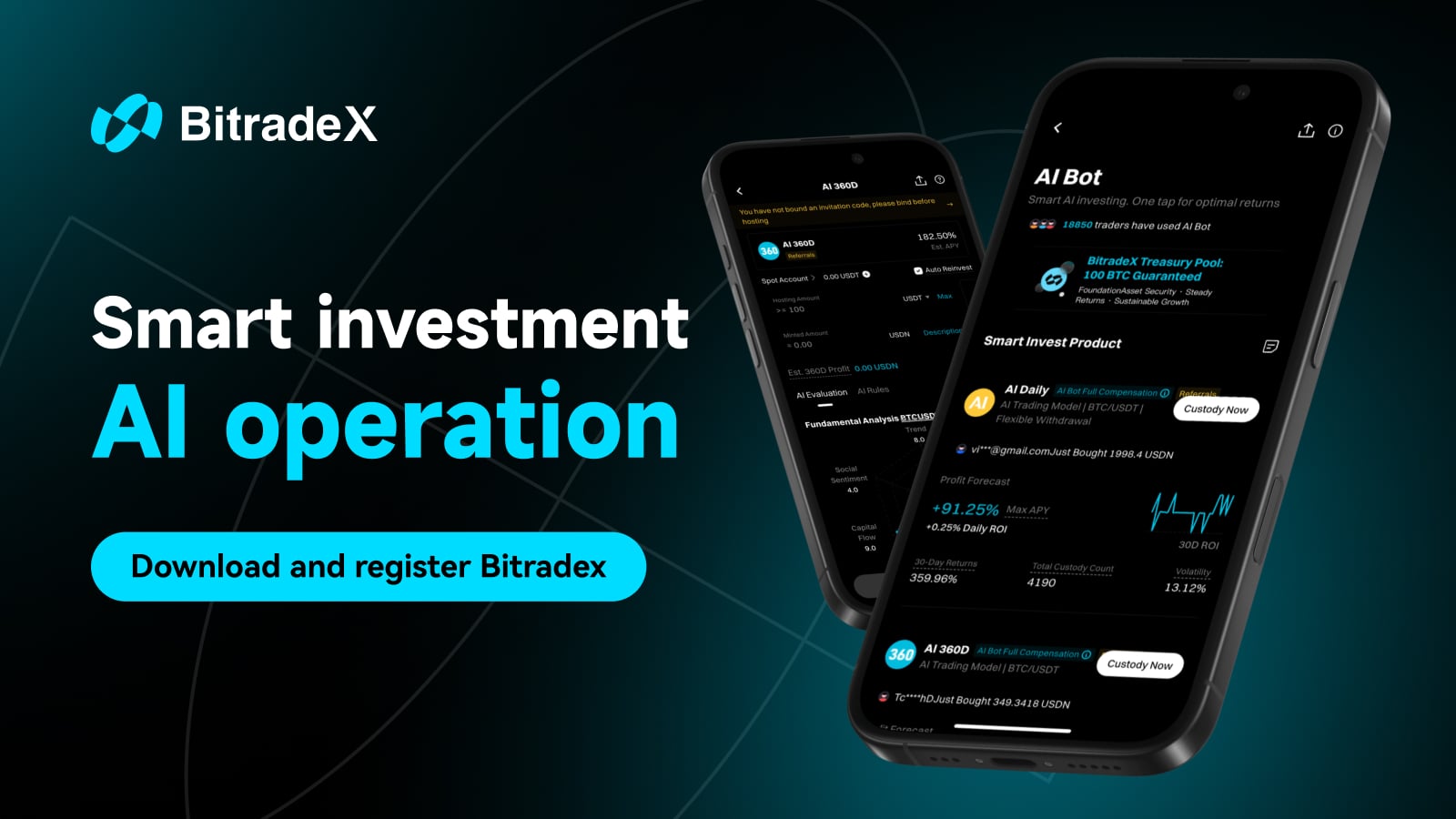
Most AI bot marketing is written for calm markets. It sounds persuasive when liquidity is normal, price action is directional, and the model has room to look smart. Tail risk is different. It shows up when markets gap, correlations break, spreads widen, and losses start clustering faster than normal risk models expect.
That is the right lens for the BitradeX AI Bot. Public BitradeX pages do not publish a formal tail-risk model, but they do describe several mechanisms that appear intended to reduce exposure when markets turn abnormal: anomaly detection, adaptive strategy logic, real-time risk control, product packaging that limits user error, and security or reserve language designed to support confidence when conditions deteriorate.
The useful reading is not “the bot promises safety.” It is “the platform appears to be building several layers that may reduce tail-risk exposure before a bad market move becomes a deeper capital event.” That is a stronger claim than a homepage slogan, but still weaker than a fully transparent methodology. So the practical question is which parts of the public BitradeX story look like real tail-risk controls, and which parts look more like backstop or reassurance layers.
Tail risk is about regime breaks, not ordinary downside
In portfolio terms, tail risk is not just a losing day. It is the risk of unusually severe losses that sit out on the extreme edge of the distribution, where markets stop behaving like their normal averages. That distinction matters because many trading products can survive routine volatility and still fail badly when market behavior becomes discontinuous.
The difference becomes even more important in crypto futures trading, where leverage can magnify unusual price moves into outsized capital damage. A platform can look disciplined during normal conditions and still have weak tail protection if it does not detect abnormal regimes early enough or react fast enough once the move is underway.
That is why BitradeX’s public “real-time risk control” language should be read as a stress question, not a branding phrase. The relevant issue is not whether the system can manage normal fluctuation. It is whether it can recognize a market regime shift early, change behavior before the loss distribution thickens, and keep both execution and user visibility coherent while markets stay unstable.
The first job is seeing the regime shift early
The strongest part of the public BitradeX tail-risk story is the detection layer. Its homepage describes the AI Bot as a product with real-time risk control and transparent tracking, while the rookie AiBot materials frame the system as an Intel, Strategy, and Risk Control workflow rather than a single trade signal engine. That matters because tail-risk reduction usually starts with recognizing that the market has stopped behaving normally.
A system drawing on broad inputs and live crypto market data has a better chance of identifying volatility clusters, dislocations, and abnormal behavior before those signals become full portfolio damage. BitradeX’s About Us page also expands the story with references to real-time market data, on-chain data, news sentiment, and AI-assisted risk control. Taken together, the public pages imply a detection layer designed to spot instability early rather than simply calculate entries and exits in a static environment.
| Public cue | Why it matters in extreme events | What still remains unclear |
|---|---|---|
| Real-time anomaly capture | Suggests the system is watching for abnormal market behavior instead of assuming conditions remain stable | No public trigger thresholds are published |
| Intel, Strategy, and Risk Control workflow | Implies risk is treated as a separate stage that can influence the strategy layer | No public override rules show when risk control takes priority |
| Risk-status visualization | Suggests users may be shown simplified defensive or warning states | The scoring logic and update cadence are not disclosed |
The limit is obvious: BitradeX shows the existence of a detection story, not the measurement logic behind it. There is still no public formula explaining what qualifies as a tail event, which indicators matter most, or how quickly the system escalates from ordinary monitoring to a more defensive state.
That gap matters because tail-risk control is often won or lost in the transition zone before a full shock becomes visible to most users. If the system recognizes stress only after liquidity has already thinned and losses have already accelerated, the detection layer may still sound sophisticated while arriving too late to be materially protective. So early detection is the right public claim to emphasize, but it is also the claim that needs the most scrutiny.
The second job is changing behavior fast enough
Detection only helps if it leads to action. Public BitradeX pages repeatedly say the ARK model adapts to changing markets, responds quickly, and can switch or optimize strategy logic across bull, bear, and volatile conditions. That is important because tail-risk exposure is often less about one wrong signal and more about staying too committed to the same behavior after the environment has shifted.
In practice, a system trying to reduce extreme-event exposure would usually need to do some combination of four things: reduce activity, shrink exposure, rotate to a different logic set, or stop trusting a signal family that no longer fits the market. BitradeX’s public pages do not spell those actions out in operational detail, but they do imply that strategy adaptation is supposed to be part of the protection layer rather than an afterthought.
That is a meaningful distinction. Many automated products sound sophisticated because the model looks advanced. But an advanced model can still be fragile if its live behavior is too rigid. BitradeX’s public language at least points in the more credible direction: adaptive strategy logic plus fast response, not just static automation.
Still, this is where caution matters most. Public pages can show intent without proving reliability. BitradeX does not publish stress logs, regime-switch thresholds, or intervention frequency. So the fairest conclusion is that the bot appears designed to reduce tail exposure through adaptation, but the actual speed and quality of that adaptation remain largely unverified from outside the platform.
Product structure can reduce user-driven tail risk too
One of the more overlooked parts of tail-risk control is the user. Extreme losses often get worse because the operator panics, overrides a system at the wrong moment, adds exposure too late, or chases recovery after a disorderly move. That is why product packaging itself can matter.
BitradeX presents its AI trading bot as a one-click product rather than a fully configurable quant console. For some users, especially those without a disciplined execution process, that can reduce one real source of tail risk: human behavior under stress. A packaged workflow may stop users from continuously interfering with entries, exits, and leverage settings in the middle of an abnormal market break.
This is also where BitradeX’s visible product formats matter. Public AI Bot pages present products such as AI Daily and AI 30-360 as structured choices rather than an open-ended strategy playground. That can help by narrowing user error, but it also creates a tradeoff. A more packaged product can reduce impulsive decisions while simultaneously making the platform’s internal control logic more important. If the user is giving up manual control, they are depending more heavily on BitradeX’s invisible risk logic during extreme conditions.
So product structure cuts both ways. It may reduce operator-driven tail risk, but it also increases transparency dependence. For a cautious user, that means the platform becomes easier to use while the need for real monitoring and clear reporting becomes even more important.
Security funds and reserve language are not the same as tail-risk control
Another place where users can get confused is the relationship between prevention and backstop. BitradeX’s public materials mention security funds, reserve display, asset segregation, multi-signature withdrawals, and real-time identification of abnormal operations. Those signals matter, but they do not all solve the same problem.
The clean way to read them is to separate pre-loss controls from post-loss or adjacent-protection layers.
What appears aimed at reducing tail exposure before losses deepen:
- anomaly detection
- adaptive strategy logic
- live risk monitoring
- risk-status visibility
What appears aimed at protecting the user around or after stress conditions:
- reserve or security-fund language
- cold and hot wallet isolation
- withdrawal controls
- abnormal-operation interception
This distinction matters because a security fund is not proof that tail-risk measurement is strong. At most, it suggests some support layer after conditions have already become adverse. Likewise, custody and withdrawal controls are important for operational safety, but they do not automatically prove the trading logic itself is resilient during abnormal volatility.
BitradeX’s broader platform materials actually make this layered reading more plausible. The About Us page frames security and compliance as a parallel protection stack: asset isolation, penetration testing, threat warning, KYC and AML, and interception of abnormal account behavior. That can strengthen the overall stress posture of the platform, but it should not be confused with evidence that the AI Bot’s market-risk model has been fully validated in public.
What a real stress test would look like for a cautious user
If you are trying to judge whether BitradeX really reduces tail-risk exposure, the best test is not the slogan. It is the workflow during disorderly conditions.
A cautious user should watch for questions like these:
- Does the dashboard show changing risk conditions early, or only after losses have already widened?
- Does the product appear to slow down, rotate, or shift posture during abnormal markets, or does it keep behaving as if nothing changed?
- If the product is flexible, can the user reduce exposure without unusual friction?
- If the product is fixed-term, does the user clearly understand the tradeoff between convenience and flexibility before a shock arrives?
- Are reserve or compensation references backed by terms a user can actually inspect?
- Do the platform’s communications stay coherent when the market is stressed, or do they remain stuck at the level of marketing slogans?
These are not abstract review questions. They are the practical checks that separate a believable tail-risk story from a polished one. A platform does not need to publish every model rule to be useful, but it does need to make its protective behavior legible enough for a serious user to evaluate.
One especially useful signal is whether the product remains understandable when conditions worsen. In real extreme events, users do not just need returns data. They need status clarity: whether the system is defensive, whether the product is still behaving normally, and whether the platform is communicating risk changes in time to matter. If those signals disappear during stress, then the visibility layer is weaker than the marketing suggests, even if the underlying model is more capable than average.
What to watch next when markets turn abnormal
Based on the public pages alone, BitradeX appears to frame extreme-event protection as a layered system: detect market abnormality early, adapt strategy behavior fast, reduce user-driven errors through product packaging, and support the broader stress environment with security and reserve language. That is more substantial than saying the bot is “smart,” and it is enough to make the product worth a closer look for users who want a managed automation path.
At the same time, the current public materials still stop short of a full proof standard. They do not show the thresholds, model rules, or stress-history evidence that would let an outside reviewer verify how much tail-risk exposure is actually reduced in practice.
So the right takeaway is practical rather than promotional. BitradeX appears to be building the right layers for extreme-event defense. The next thing a careful user should watch is whether those layers stay visible and coherent when the market stops behaving normally.
Disclaimer
Digital asset prices can be volatile. This article is for informational purposes only and should not be treated as investment, legal, tax, or financial advice. Users are responsible for their own trading decisions and should evaluate whether any product or transaction is appropriate for their circumstances.