 By BitradeX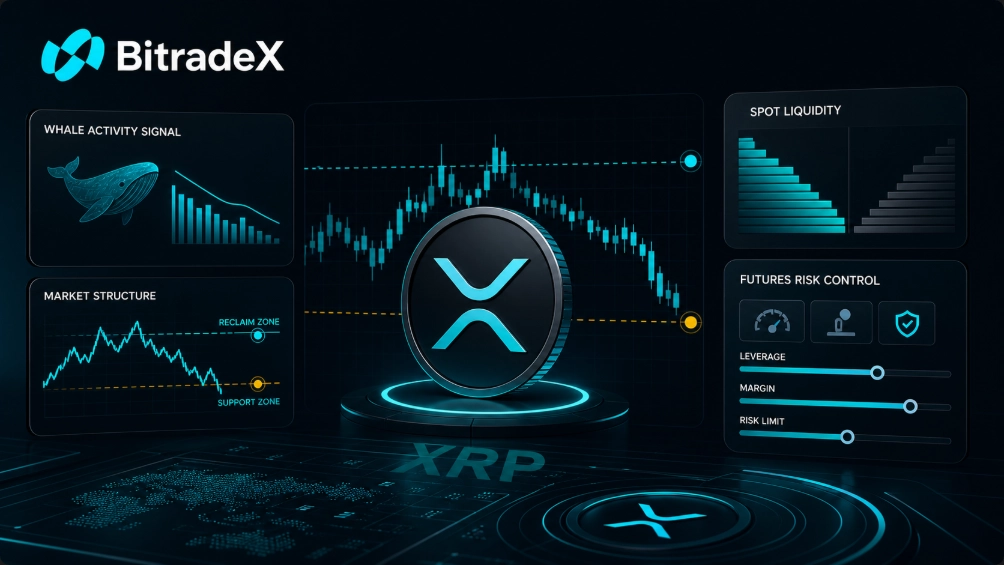
The headline number is sharp: large XRP transactions reportedly fell from 157 to 67 in nine days, a 57.3% drop. That sounds like a prediction by itself. It is not.
Whale silence can mean several things. Large wallets may be waiting for a cleaner level. They may be avoiding a weak tape. They may have already acted before the breakdown. They may simply be less active because the market has not reached the price or liquidity they want. A lower whale count does not say whether XRP must rise or fall. It says the next move should be judged by price reaction, liquidity, and whether large-wallet activity returns at the right level.
That is why a useful XRP price prediction should not begin with “whales are quiet, therefore bullish” or “whales are quiet, therefore bearish.” It should begin with the break in structure, then ask whether the market can reclaim the level it lost.
Quick Answer
The near-term XRP forecast is cautious until price proves it can reclaim the former support area around $1.30. In the May 23, 2026 snapshot that triggered this discussion, XRP traded near $1.3116 after breaking below a multi-month symmetrical triangle base. The same snapshot reported that large XRP transactions above $1 million fell from 157 to 67 over nine days.
That combination is not automatically bearish, but it is fragile. If XRP reclaims $1.30 and large transactions recover toward or above 100 per day, the market can argue that whale inactivity was a pause rather than distribution. If price loses the $1.20 to $1.15 area while large-wallet activity remains thin, the breakdown becomes more convincing.
For traders, the first task is not to predict the final destination. It is to define what would invalidate the current read.
The 57% Whale Drop Is a Context Signal, Not a Trade Signal
Whale transaction data is useful because large transfers can reveal participation from wallets big enough to affect liquidity. But the direction matters less than many headlines imply.
A drop from 157 large transfers to 67 is meaningful because it shows that high-value activity cooled quickly. The mistake is assuming that quiet whales are secretly accumulating or secretly preparing to sell. On-chain transaction count does not tell you intent. It shows movement, not motive.
There are three cleaner interpretations:
| Whale activity pattern | Price behavior | Better read |
|---|---|---|
| Whale activity falls while price holds support | Large wallets may be waiting, and sellers may be losing pressure. | |
| Whale activity falls while price breaks support | The market may be losing sponsorship at the level that mattered. | |
| Whale activity rises after a reclaim | Larger wallets may be re-engaging after confirmation. |
In the May 2026 setup, the second row mattered most. Whale activity fell while XRP was losing the structure that had contained price for months. That does not prove distribution, but it does remove one source of confidence: large wallets were not visibly defending the level.
The $1.30 Level Matters More Than the Headline
The reference setup described XRP losing the base of a symmetrical triangle that had held since February. The first important level was not an ambitious upside target. It was the old support around $1.30.
Once support breaks, it often becomes the first test of any recovery. If XRP can close back above that level with stronger volume and renewed whale activity, the breakdown starts to look less decisive. If it cannot, the market may treat $1.30 as resistance and look lower.
The next downside area in the reference snapshot was the February low around $1.15. The gap between those levels is important because there was little clean structure between $1.30 and $1.15. When a chart has a thin support zone, a failed reclaim can move faster than traders expect.
This is also where XRP spot traders need a different mindset from long-range holders. A page for watching XRP/USDT spot liquidity is useful for reviewing live depth and spread behavior, but it does not turn a broken level into a reliable bottom. It simply gives the trader a cleaner view of whether liquidity is improving or thinning as price retests the area.
ETF-Flow Headlines Can Be Bullish and Still Not Save the Chart
The reference article also pointed to positive fund-flow headlines while price was weakening. That creates a familiar market tension: institutional demand can look constructive, while the chart still refuses to respond.
The mistake is choosing one side and ignoring the other. Fund inflows can matter because they suggest demand is not only retail. But if price keeps sliding despite those inflows, the market is telling you that other sellers, liquidity conditions, or derivative positioning may be absorbing that demand.
That is not unusual in crypto. A token can have a strong narrative and a weak short-term structure at the same time. XRP can have long-term believers, regulatory headlines, and active trading interest while still needing to defend a technical level this week.
For a practical XRP price prediction, the better question is: does positive flow eventually show up as a reclaimed level, or does it remain a headline while price keeps failing at resistance?
The Leverage Layer Can Distort the Move
XRP does not trade only in spot markets. Perpetual futures can amplify moves because leveraged positions are sensitive to funding, margin, and liquidation levels. That matters most after a support break, when traders may crowd into short-term directional bets.
If XRP bounces from a weak support area, short positions can cover quickly. If it loses another level, long positions can be forced out quickly. Neither reaction necessarily proves a long-term thesis. It may only show that leverage was clustered too tightly around the same price.
That is why leveraged XRP/USDT exposure should be treated as a high-risk tactical tool rather than a way to express confidence in a price prediction. Futures trading can magnify both gains and losses, and liquidation risk can turn a correct broad thesis into a bad trade if timing and position size are wrong.
A Better XRP Forecast Uses Conditions, Not Certainty
The strongest XRP forecast from this setup is conditional.
The recovery case starts with a daily reclaim of the $1.30 area. That reclaim becomes more persuasive if whale transactions recover from the sub-70 zone toward stronger participation and if price can hold above the reclaim instead of immediately falling back below it. In that case, the 57% whale decline may have been a pause during compression rather than a signal of abandonment.
The breakdown case starts with failure at $1.30. If XRP rejects the level, large-wallet activity stays low, and price slides toward $1.20 or $1.15, the market has less reason to assume buyers are waiting just below. In that case, the old triangle base becomes resistance, not support.
The noisy case is the most common. XRP chops around the broken level, headlines stay mixed, and whale activity recovers for a day or two without a clean price response. That is the environment where traders usually overtrade. The better response is to reduce the number of assumptions, not add more indicators.
What Would Make the Prediction Stronger?
A credible XRP price prediction should change when the evidence changes. The key variables are simple:
| Evidence to watch | Constructive reading | Cautious reading |
|---|---|---|
| $1.30 reclaim | Price closes back above former support and holds it. | Price rejects the level and treats it as resistance. |
| Whale transactions | Large transfers recover with price strength. | Large transfers stay low while price weakens. |
| $1.15 support | Price does not need to test it, or wicks into it and recovers. | Price closes below it and opens lower support exploration. |
| Spot liquidity | Order book depth improves near the reclaim. | Liquidity thins and spreads widen during volatility. |
| Leverage positioning | Futures activity stays controlled. | Crowded leverage accelerates liquidations. |
This table is more useful than a single target. It gives traders a way to update the view without pretending that one whale metric can predict the next several candles.
Bottom Line
The XRP price prediction after a 57% drop in whale transactions should be cautious, not dramatic. Whale silence is information, but it is incomplete information. The more important test is whether XRP can reclaim the level it lost and whether larger wallets return when that reclaim happens.
If XRP regains $1.30 with stronger participation, the breakdown can lose force. If it fails there and moves toward $1.15, the bearish structure becomes harder to dismiss. Until one side proves itself, traders should treat this as a fragile compression setup, not a clear invitation to chase.
BitradeX users who register to review XRP markets should do so for access, tools, and market visibility, not because any whale metric points to a certain outcome.
FAQ
What is the XRP price prediction after whale transactions dropped 57%?
The cautious view is that XRP needs to reclaim the former $1.30 support area before a recovery case becomes stronger. A 57% drop in whale transactions shows lower large-wallet activity, but it does not predict direction by itself.
Is lower whale activity bullish or bearish for XRP?
Lower whale activity is neither automatically bullish nor automatically bearish. It depends on price behavior. If whale activity falls while price holds support, it may suggest waiting. If it falls while price breaks support, it may show that large wallets are not defending the level.
Why is the $1.30 XRP level important?
The $1.30 area mattered because it was described as the former base of a multi-month triangle. After a support break, that area can become resistance unless price reclaims it and holds above it.
What happens if XRP loses $1.15?
If XRP loses the $1.15 area, the breakdown case becomes stronger because the market would have failed both the former $1.30 support and the next major downside reference from the May 2026 setup.
Should traders use XRP futures for this setup?
XRP futures can be used by experienced traders who understand leverage, margin, funding, and liquidation risk. They should not be treated as a safer or more certain way to act on a price prediction.
Disclaimer
Digital asset prices can be volatile. This article is for informational purposes only and should not be treated as investment, legal, tax, or financial advice. Users are responsible for their own trading decisions and should evaluate whether any product or transaction is appropriate for their circumstances.