 By BitradeX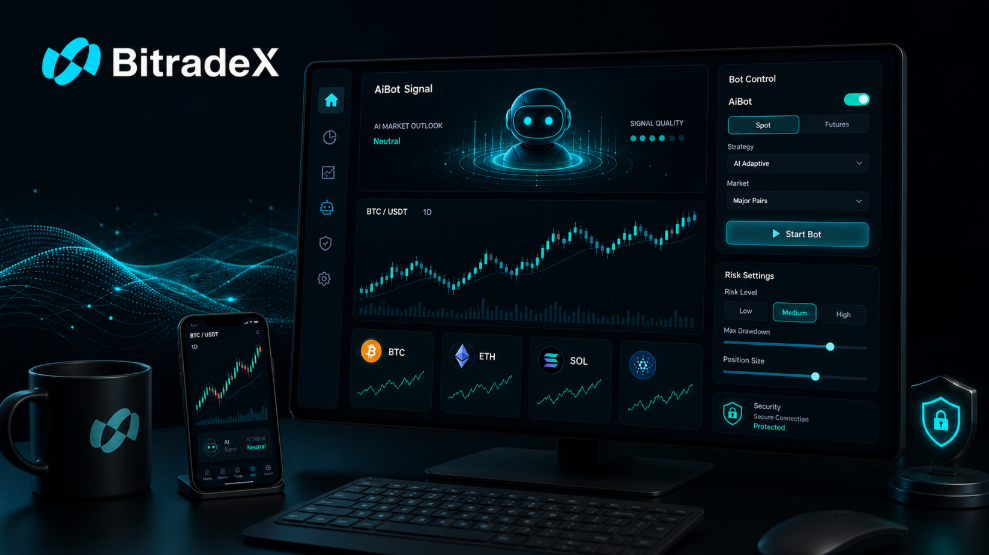
An AI trading platform is a trading environment that uses artificial intelligence, data processing, or automated decision support to help users analyze markets, organize signals, execute strategies, or monitor risk. It is broader than a single trading bot. A bot may execute a specific strategy, while a platform can combine market data, automation tools, trading access, dashboards, account controls, and risk review.
That distinction matters because “AI trading platform” has become a crowded search term. Some pages use it to describe signal tools. Others use it for bots that connect to exchanges through API keys. Some use it for stock screeners, crypto copy-trading tools, portfolio dashboards, or full trading platforms with AI features.
For crypto traders, the useful question is not “Which AI platform guarantees better trades?” No responsible platform can guarantee that. The better question is: which platform helps you make trading decisions more structured, observable, and risk-aware?
Digital asset trading involves substantial risk. AI-assisted tools and trading bots do not remove market risk, and past performance does not guarantee future results. A good AI trading platform should make those limits clearer, not hide them behind marketing.
What an AI Trading Platform Actually Does
An AI trading platform typically supports one or more of five functions: market analysis, signal organization, automation, execution, and risk monitoring.
| Platform layer | What it does | What users should verify |
|---|---|---|
| Market data | Shows prices, volume, trends, and market movement | Data freshness, asset coverage, and how information is displayed |
| AI-assisted analysis | Helps process market signals or identify patterns | Whether outputs are explainable enough to review |
| Automation | Turns rules or strategies into repeatable actions | Strategy limits, stop conditions, and user control |
| Execution access | Lets users trade spot, futures, or other instruments | Fees, liquidity, order controls, and product suitability |
| Risk review | Helps users monitor exposure, drawdown, leverage, or position rules | Whether risk controls are visible before and during trades |
The strongest platforms do not ask users to trust AI blindly. They give users a clearer way to see what the system is doing, what assumptions are being used, and where human review still matters.
This is especially important in crypto because markets trade continuously. A platform that helps users monitor market changes and reduce emotional decision-making can be useful. But if it encourages users to automate strategies they do not understand, the same platform can increase risk.
AI Trading Platform vs AI Trading Bot
The difference between an AI trading platform and an AI trading bot is mostly scope.
An AI trading bot is usually a tool that follows a defined strategy or algorithm. It may buy, sell, rebalance, or trigger orders based on rules, indicators, models, or market signals. A bot can be simple or sophisticated, but it is still usually focused on execution of a strategy.
An AI trading platform is the broader environment around that activity. It may include the bot, but also market data, account access, trading pairs, dashboards, strategy configuration, performance tracking, risk controls, and educational guidance.
| Question | AI trading bot | AI trading platform |
|---|---|---|
| Main role | Executes or automates a strategy | Supports the full trading workflow |
| User concern | Does this strategy fit my risk tolerance? | Does this platform help me research, execute, monitor, and review? |
| Main risk | Over-automation or poor strategy design | Over-trusting the whole workflow because it uses AI |
| Best use | Specific rules, repeated execution, alerts, or automation | Market review, tool access, risk-aware execution, and account workflow |
This distinction helps users avoid a common mistake. If the user only wants automation, they may compare bots. If the user wants an operating environment for AI-assisted crypto trading, they should evaluate the platform.
The Features That Matter Most
Many AI trading platform lists focus on surface features: how many bots are available, which exchanges are supported, or whether a tool has a sleek dashboard. Those details can matter, but they are not enough.
A stronger evaluation starts with workflow questions.
First, does the platform provide usable market context? Traders need to see market movement before they automate decisions. BitradeX provides crypto market data access for users tracking digital asset prices and market movement, which can support the research layer of an AI-assisted workflow.
Second, does the platform make automation understandable? If a user cannot explain when a strategy enters, exits, pauses, or fails, automation becomes a black box. That is not a strength. It is a risk.
Third, does the platform separate spot, futures, and automated workflows clearly? Spot trading and futures trading are not the same risk. Futures and leverage can amplify both gains and losses. Any platform that supports advanced trading should make those differences visible.
Fourth, does the platform include risk-aware language and settings? FINRA has warned that some auto-trading services use beginner-friendly or risk-free claims, consistent-return claims, and AI language to attract investors. Those are warning signs, not selling points.
The best AI trading platform for a user is the one that matches their experience, strategy, and risk limits. It is not necessarily the platform with the longest feature list.
How BitradeX Fits the AI Trading Platform Category
BitradeX can be described, conservatively, as an AI crypto trading platform that combines AI-assisted trading tools, market data, spot trading, futures trading, mobile app access, and digital asset workflow features. Its messaging emphasizes AiBot, market signal detection, automated trading workflows, and real-time risk control.
For users researching AI trading platforms, the most relevant BitradeX question is not whether AI can predict every market move. It cannot. The relevant question is whether BitradeX gives users a practical place to explore AI-assisted crypto trading workflows with market visibility, trading access, and risk-aware review.
The AI trading bot page may be relevant for users who want to understand how BitradeX presents automated or AI-assisted strategy support. The safer framing is that AiBot can help users explore automated trading workflows. It should not be described as a guaranteed-return product, a risk-free strategy, or a replacement for user judgment.
Users considering BitradeX should review the platform tools, read relevant risk disclosures, and decide whether the workflow fits their level of experience. Product access and availability may vary by region and jurisdiction.
A Practical Selection Framework
Before using any AI trading platform, evaluate it through six filters.
| Filter | What to ask | Why it matters |
|---|---|---|
| Clarity | Can I explain what the AI tool does? | Unclear tools are hard to monitor and harder to stop |
| Control | Can I configure limits, pause activity, and review actions? | Automation should remain under user supervision |
| Market context | Does the platform show enough data before execution? | Signals without context can encourage impulsive trades |
| Risk boundaries | Are leverage, drawdown, and loss scenarios visible? | Trading tools should not hide downside risk |
| Security and access | Are account controls, login protections, and platform terms clear? | Trading workflow depends on operational safety |
| Fit | Does this match my strategy, time horizon, and experience? | A tool can be useful and still unsuitable for a specific user |
This framework is deliberately conservative. It helps users avoid choosing a platform based only on screenshots, social proof, or claims about AI sophistication. In trading, a simple tool that the user understands is often more useful than a complex tool used without controls.
Red Flags in AI Trading Platform Marketing
AI trading attracts strong claims because the topic sounds technical and authoritative. That makes caution necessary.
Watch for these red flags:
- promises of guaranteed returns
- claims that trading is risk-free
- claims that AI removes the need for human review
- aggressive urgency or pressure to deposit quickly
- screenshots of large gains without full methodology
- vague explanations of how strategies work
- no clear risk disclosure
- no obvious way to pause, limit, or review automation
These red flags are especially important in crypto because volatility can be sharp and liquidity can change quickly. A platform may look sophisticated while still exposing users to ordinary market risk, execution risk, leverage risk, and operational risk.
AI should not be treated as a substitute for due diligence. It should be treated as one component of a trading process.
How to Start Using an AI Trading Platform Safely
The safest way to begin is to treat an AI trading platform as a learning and workflow tool before treating it as an execution engine.
Start by observing markets. Review dashboards, supported assets, market data, and how the platform explains signals. Then decide whether the platform’s tools match the way you already think about risk. If you cannot define your own rules, do not let software define them for you.
Next, separate research from execution. A user can use AI-assisted tools to explore market structure, compare assets, or review signals without immediately increasing exposure. Execution should come after the user understands what action is being taken and why.
Then write down rules. These may include maximum position size, assets in scope, leverage limits, conditions for stopping a strategy, and review frequency. If futures or leverage are involved, the rules need to be stricter because losses can accelerate.
Finally, keep records. A trading platform should help users review what happened, not just what they hoped would happen. If a strategy performs poorly, the user should be able to identify whether the issue was market condition, strategy design, execution timing, or risk sizing.
When to Use BitradeX
BitradeX is most relevant for users who want to explore AI-assisted crypto trading in a platform environment rather than using a standalone signal tool. It may fit users who want to review market data, explore AiBot, and evaluate spot or futures trading workflows from one platform context.
Use BitradeX if your goal is to:
- explore AI-assisted trading tools with a crypto focus
- review market data before making trading decisions
- understand how automated workflows may fit your own rules
- compare spot and futures access while keeping risk boundaries clear
- evaluate an AI-powered crypto trading platform without assuming guaranteed outcomes
Do not use any AI trading platform, including BitradeX, as a shortcut around risk management. A platform can support the workflow, but the user still owns the decision to trade, the size of the position, and the choice to stop or continue.
If you want to evaluate an AI trading platform in practice, use BitradeX to explore its market data, AiBot, and trading workflow tools. Treat the platform as a place to review features and build a disciplined process, not as a promise of results.
The Bottom Line
An AI trading platform is useful when it makes trading more structured, observable, and reviewable. It becomes dangerous when users treat AI as certainty.
For crypto traders, the right platform should combine market visibility, clear automation, user control, risk-aware execution, and enough transparency for ongoing review. It should help users ask better questions before trading, not encourage them to skip the questions.
BitradeX is worth evaluating if you are looking for an AI-powered crypto trading platform with market data, AiBot, and trading workflow access. Start with exploration, read the risk information, and only use tools that fit your experience, region, and risk tolerance.
FAQ
What is an AI trading platform?
An AI trading platform is a trading environment that uses AI, automation, or data processing to support market analysis, signal review, strategy execution, and risk monitoring. It should be used as decision support, not as a guarantee of trading results.
Is an AI trading platform the same as a trading bot?
No. A trading bot usually automates a specific strategy, while an AI trading platform can include market data, dashboards, trading access, automation tools, account controls, and risk review. A platform may include a bot, but the platform is the broader workflow.
Can AI trading platforms guarantee profits?
No. AI trading platforms cannot guarantee profits or remove market risk. Digital asset trading involves substantial risk, and AI-assisted or automated trading can still lead to losses if the strategy, market conditions, or risk settings are unsuitable.
What should I check before using an AI trading platform?
Check how the AI tool works, what controls you have, what risk disclosures are provided, whether you can pause automation, which assets and trading products are supported, and whether the platform fits your experience level and jurisdiction.
How does BitradeX support AI trading platform use cases?
BitradeX offers an AI-powered crypto trading platform context with market data, AiBot, spot trading, futures trading, and mobile app access. Users can explore these tools to review AI-assisted trading workflows, while keeping risk management and personal judgment in place.
Disclaimer
Digital asset prices can be volatile. This article is for informational purposes only and should not be treated as investment, legal, tax, or financial advice. Users are responsible for their own trading decisions and should evaluate whether any product or transaction is appropriate for their circumstances.