 By BitradeX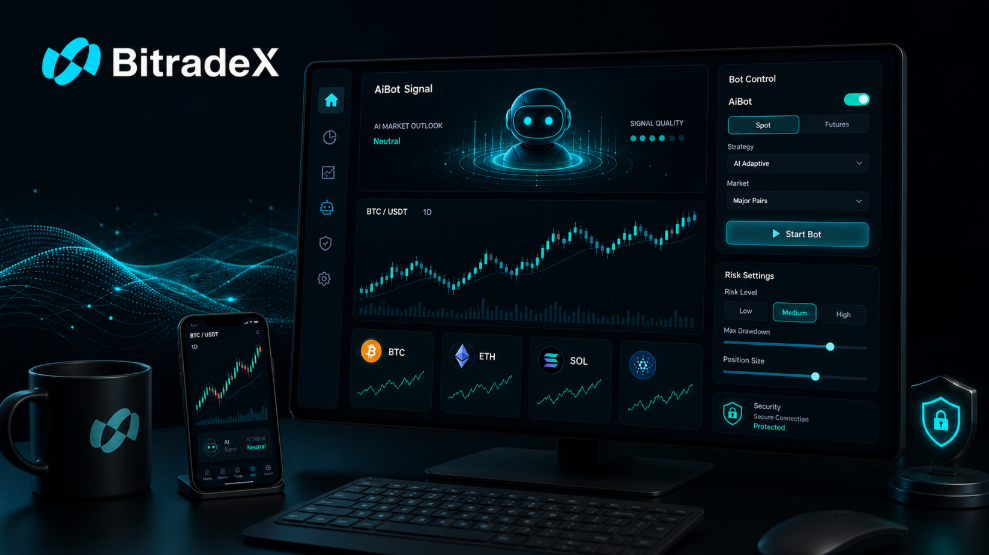
AI can make crypto trading feel easier before it actually becomes safer. That is the trap beginners need to understand. The useful question is not whether AI can scan markets, summarize sentiment, or trigger automated actions. It can. The better question is whether the user has built a workflow that keeps AI from turning every interesting signal into a trade.
For beginners searching for how to use AI to trade crypto, the practical starting point is a control stack: research, signal, risk gate, execution, and review. AI can assist each layer, but it should not own the whole chain. If the tool suggests an idea, sizes the position, enters the order, and explains the result without a separate human rule, the user has not automated a strategy. They have automated uncertainty.
First, Decide What AI Is Allowed to Touch
Before choosing a bot or platform, define the parts of trading AI may touch.
| Workflow layer | AI can help with | The user should still decide |
|---|---|---|
| Research | Summarizing market context, news, and asset basics | Which assets are in scope |
| Signal | Flagging conditions that match a rule | Whether the condition matters |
| Risk gate | Checking size, exposure, and stop rules | Maximum loss and account limits |
| Execution | Supporting an automated or assisted workflow | Whether live trading is allowed |
| Review | Organizing logs and rule breaks | Whether the strategy continues |
This table matters because many “crypto AI trade” searches jump straight to the signal layer. Beginners see AI as a way to reduce screen time or remove hesitation. But if the allowed assets, trade size, invalidation rule, and review cadence are not written down first, faster signals usually mean faster confusion.
AI is useful when it makes a process more visible. It is risky when it makes the process feel optional.
Use AI to Compress Research, Not to Invent Conviction
The most controlled beginner use case is research compression. Ask AI to explain what a coin or trading pair is, summarize recent market context, define unfamiliar terms, and list what information is missing. This saves time without handing over trading authority.
A strong research prompt is narrow:
Summarize BTC/USDT market context for a beginner using only price trend, volume context, volatility, and key risk factors. Do not recommend a trade.
A weak prompt is broad:
Find me a crypto trade.
The first prompt produces information a rule can inspect. The second prompt asks the system to create a reason for action.
This distinction also protects the reader from AI washing. FINRA’s July 29, 2025 investor alert on auto-trading services offered by unregistered entities warns that some services market themselves as beginner-friendly, reference AI, and make unsupported performance claims. For a beginner, the response should be simple: if the provider cannot explain what the AI does, what permissions it needs, and how risk is limited, do not treat the label “AI” as evidence of quality.
Turn Signals Into Questions
AI signals should not be treated as instructions. Treat them as questions.
If an AI tool flags a possible trade, run it through four checks:
- What rule produced this signal?
- What market condition would invalidate it?
- How much can the account lose if the idea is wrong?
- What must be reviewed afterward?
If any answer is missing, the signal is not ready for execution.
This is where beginners often misunderstand automation. A trading bot may execute a rule consistently, but consistency does not make the rule sound. A model may explain why a setup looks attractive, but explanation does not make the setup durable. A dashboard may show activity, but activity is not discipline.
The point of AI is not to make every signal actionable. The point is to make fewer signals worth considering.
Build a Risk Gate Before Any Live Order
The risk gate is the most important part of AI-assisted crypto trading because it is where automation slows down.
A beginner risk gate should include:
- maximum position size
- maximum daily or weekly loss
- assets allowed for AI-assisted review
- leverage permission, if any
- stop or invalidation rule
- manual override process
- review date
The CFTC’s customer advisory, AI Won’t Turn Trading Bots into Money Machines, is blunt about why this layer matters. The advisory says scammers exploit interest in AI to promote automated trading algorithms and crypto-asset schemes, and it notes that AI cannot know future market changes. It also cites the Mirror Trading International case, where more than $1.7 billion in bitcoin was stolen from at least 23,000 people.
That example is not a reason to reject every AI-assisted tool. It is a reason to reject any workflow where the user cannot verify the provider, understand permissions, cap risk, and stop activity.
Use Paper Testing as the First Execution Layer
For beginners, paper testing is not a formality. It is where the workflow proves whether it can follow instructions.
Run the AI-assisted process without live funds first. Let it generate research summaries, flag candidate setups, apply the risk gate, and produce a review log. Then check whether the system behaves the way the written process says it should.
Useful questions during paper testing:
- Did AI introduce assets outside the approved list?
- Did it create a trade idea without a written rule?
- Did it ignore the maximum size or loss limit?
- Did it explain risk in plain language?
- Did the review log show why a trade was accepted or rejected?
If paper testing creates more questions than answers, that is useful information. It means the workflow is not ready for live execution.
A Beginner-Friendly Operating Rule
Here is the operating rule that keeps the whole process grounded:
Use AI before the trade to organize information, during the trade only inside predefined limits, and after the trade to improve the review. Do not use AI to decide how much risk you can afford.
That rule is simple, but it changes the whole workflow. It keeps AI in the role of assistant, checker, and recordkeeper. It keeps the human in charge of scope, size, permission, and continuation.
AI can help beginners trade crypto only when it makes the trading process more inspectable. If it makes the process faster but less explainable, the user has not gained control. They have only made the unknown move faster.
Evaluate Tools After the Stack Exists
Only after the control stack exists does a product review become useful. BitradeX materials describe AiBot as an AI-assisted trading workflow with market signal detection, dashboards, automated strategy support, and risk-control language. That makes it relevant after the user has written the five layers above.
A restrained way to evaluate any AI-assisted tool is to compare it against the five layers: research, signal, risk gate, execution, and review. Does the workflow make signals inspectable? Can the user keep limits visible? Is the product being used to support a rule, or to avoid writing one?
Readers who want a product-specific next step can review an AI-assisted trading workflow and compare it with their own rules before using live funds. AI-assisted tools do not remove market risk, and product availability or terms should be checked directly before use.
FAQ
How can beginners use AI to trade crypto?
Beginners can use AI for research summaries, market context, watchlist organization, signal review, paper testing, and trade-log analysis. Position size, leverage, asset scope, and stop rules should remain under human control.
What does crypto AI trade mean?
Crypto AI trade usually refers to using artificial intelligence or automation to analyze crypto market data, monitor signals, support strategy rules, or assist execution. It should not be treated as proof that a trade is correct.
Can AI trading bots reduce risk?
AI tools may help enforce a written process, flag rule breaks, or reduce impulsive decisions, but they do not remove market, liquidity, execution, security, or platform risk.
Should beginners use real money with AI trading immediately?
Beginners should usually test the workflow first without live funds. Paper testing can reveal whether the tool follows asset limits, position-size rules, invalidation rules, and review requirements.
How should I evaluate an AI-assisted trading tool?
Evaluate any AI-assisted trading tool against your own control stack: research, signal, risk gate, execution, and review. Treat it as workflow support, not as a substitute for risk limits or personal judgment.
Disclaimer
Digital asset prices can be volatile. This article is for informational purposes only and should not be treated as investment, legal, tax, or financial advice. Users are responsible for their own trading decisions and should evaluate whether any product or transaction is appropriate for their circumstances.