 By BitradeX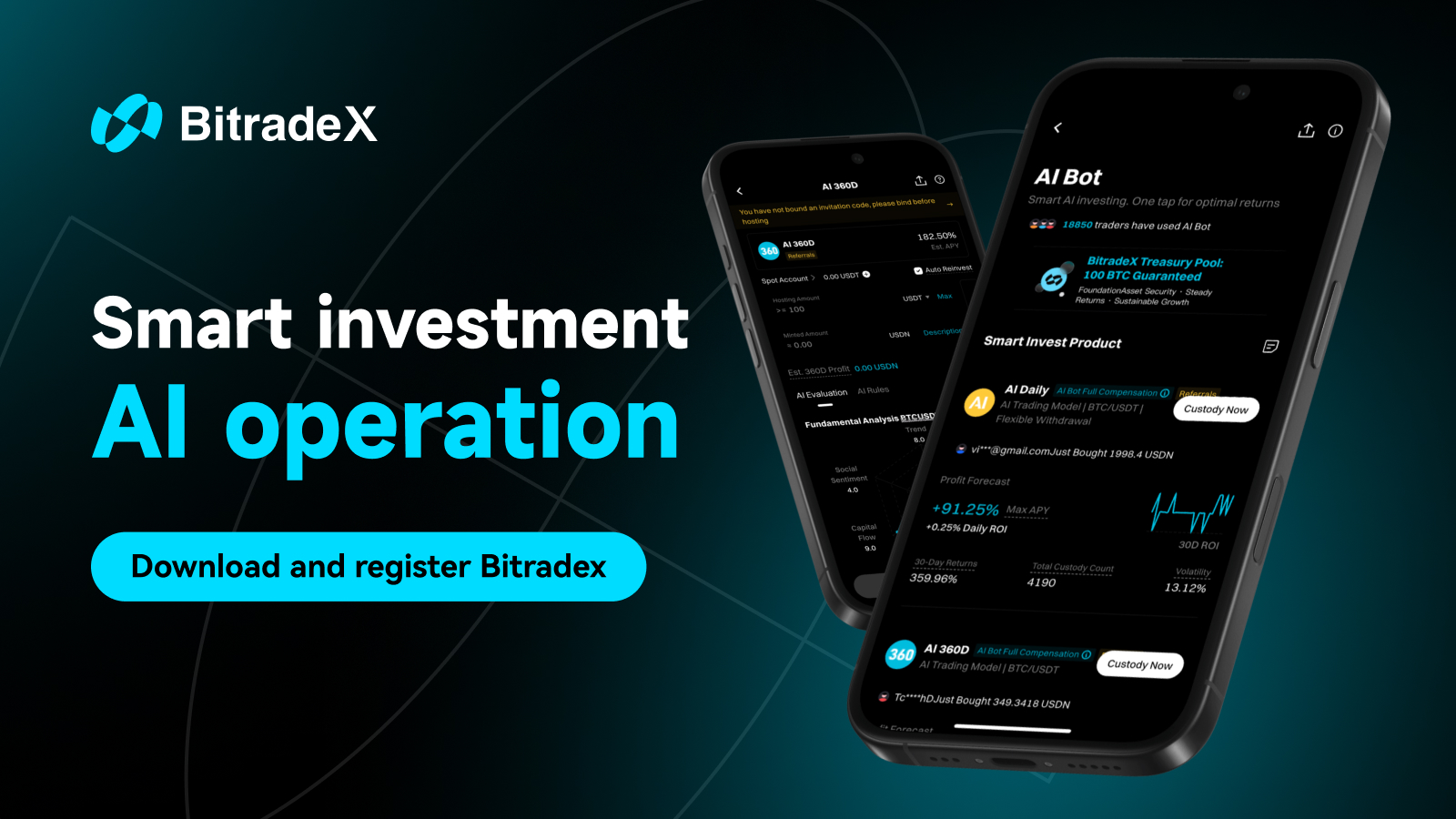
Most users start this comparison in the wrong place. They see "deposit and withdraw anytime" on a crypto product page, then mentally file it next to their money market fund. Both seem liquid. Both seem low-effort. So the assumption is they serve roughly the same purpose with different branding.
That assumption is where the comparison usually fails. Daily access describes how quickly you can move capital. It says almost nothing about what the capital is doing while it sits there. A money market fund invests in short-duration, low-risk instruments and tries to keep its share price stable at $1.00. BitradeX AI Daily, based on its public product page, is described as a flexible AI-managed crypto allocation with real-time signal monitoring and return-seeking automation. One is structured around capital preservation. The other is structured around active yield generation inside a crypto environment. Calling both "liquid products" is technically true but practically misleading.
Why the analogy breaks before it starts
The confusion usually comes from surface-level feature overlap. Both products offer daily access. Both avoid long lock-up periods. Both sound simple to use. A user scanning product pages quickly may see more similarities than differences.
But simplicity of access is not the same as simplicity of risk. A savings account at a traditional bank also offers daily access. So does a leveraged futures position. Access tells you about timing. It tells you nothing about what kind of loss model the capital enters once it is deployed.
For money market funds, the loss model is narrow by design. The U.S. Securities and Exchange Commission requires money market funds to hold only high credit quality, short maturity securities. Most retail and government money market funds maintain a stable $1.00 net asset value per share. The entire product category exists to make capital behave predictably, even when markets get noisy.
For AI Daily, the loss model is tied to crypto strategy execution, market conditions, and platform performance. Public BitradeX materials describe real-time anomaly capture, millisecond signal response, and a $10 million security fund mechanism. Those are features of a managed, return-seeking system, not features of a cash-equivalent instrument. The capital is not parked. It is working inside a strategy framework, and strategy frameworks have variable outcomes.
That distinction is fundamental and it gets lost when users compare based on access alone.
What money market funds are actually built to do
Money market funds are mutual funds that invest in cash and cash-equivalent securities. According to the SEC's investor education resources, they pay dividends reflecting short-term interest rates and carry relatively low risk compared to other mutual funds and most other investments. They are redeemable on demand, meaning investors can sell shares back on any business day at net asset value.
The purpose is clear: store capital with minimal volatility and immediate access. Returns are secondary. Capital stability is the product. This is why money market funds are commonly used for emergency reserves, short-term obligations, operating cash, or capital the user cannot afford to see move much. Many investors use them simply as an alternative to bank savings vehicles.
The worst-case scenario for most money market users is not missing upside. It is finding out the money behaved unexpectedly when it should not have. The product category has historically delivered on that promise, with very few exceptions in unusual market stress events. Even during periods of rate volatility, money market funds have generally maintained their core promise of capital preservation and immediate access.
What AI Daily describes instead
| Feature | Money market-like product | AI Daily on BitradeX |
|---|---|---|
| Capital objective | Preserve principal, maintain near-cash stability | Seek return through AI-managed strategy allocation |
| Underlying exposure | Short-term, high-credit instruments | Crypto market signals, strategy execution, platform logic |
| Return driver | Short-term interest rates | Strategy performance, market conditions, product mechanics |
| Access model | Redeemable on demand, stable NAV target | Deposit and withdraw anytime, flexible allocation |
| Downside character | Historically narrow, designed to avoid surprises | Variable, tied to strategy outcomes and market behavior |
| Regulatory context | SEC-regulated, SIPC-eligible at brokerages | Crypto platform product, different regulatory framework |
The table makes the structural difference visible. Both products offer fast access, but the risk profile underneath is fundamentally different. Money market funds are designed to minimize surprises. AI Daily is designed to capture opportunities, which means the capital lives inside a system where outcomes depend on execution quality, signal accuracy, and market conditions.
BitradeX's AI trading bot page reinforces this framing. The platform describes 50,000+ omnidimensional intelligence signals, real-time anomaly detection, and a fund pool guarantee mechanism. Those are indicators of a managed trading system with built-in support features, not a passive cash vehicle. The language is about performance optimization, not capital preservation.
This is also where public language needs careful reading. "Deposit and withdraw anytime" describes operational mechanics. It does not describe the return or loss model. A product can be easy to exit and still expose capital to outcomes that look nothing like a money market fund.
The return source matters more than the access schedule
This is the part most comparisons skip entirely.
When users compare money market yields with crypto yield products, they usually compare the number first. Money market yields in 2026 tend to sit around 4-5% annually, reflecting the prevailing interest rate environment. Crypto yield products can advertise materially higher figures. The number looks like the important variable, and users naturally gravitate toward the bigger one.
It is not the important variable. The important variable is where the return comes from.
For a money market fund, the return comes from lending to high-quality, short-term borrowers or holding government-backed securities. The risk is low because the borrowers are strong and the duration is short. The yield reflects the rate environment. It is boring by design and boring by intent.
For AI Daily, the return comes from strategy execution inside crypto markets. That means the yield is a function of volatility, signal quality, market regime, and platform execution. In favorable conditions, the strategy may generate consistent results. In dislocated or low-volatility markets, the same strategy faces a fundamentally different challenge. The return is dynamic by design, which means it can also disappoint by design.
Comparing the numbers without comparing the sources produces a misleading picture. A product offering daily returns tied to crypto strategy logic is not doing the same thing as a product offering annual yield from short-term Treasury instruments. The magnitude differs because the mechanism differs. And the mechanism tells you far more about what can happen on a bad day.
This is also why historical performance comparisons between the two categories are structurally unreliable. A money market fund's past returns are tightly correlated with interest rate policy and tend to move within a predictable band. A crypto strategy product's past returns reflect a specific market regime that may or may not repeat. Using one favorable period to project future performance across both categories misses the point. The comparison should be about mechanism stability, not about which number looked bigger during a particular quarter.
What protection language actually means in each case
Both product categories use some form of protection language. But what that language refers to differs significantly.
For money market funds, protection is structural. Government money market funds hold government securities. Retail money market funds maintain stable NAV policies. When held at a brokerage, they may be eligible for SIPC protection. The protection is not a separate feature bolted onto the product. It is baked into how the product is constructed from the start.
For AI Daily, protection language centers on a different mechanism. BitradeX describes a $10 million security fund and a fund pool guarantee that automatically covers shortfalls when returns do not meet expectations. That is a support structure, not a risk-elimination structure. It addresses a specific failure mode, but it does not change the fundamental exposure model. The capital is still inside a return-seeking crypto strategy. The guarantee mechanism affects what happens after a bad outcome, not whether bad outcomes can occur.
Users should not confuse a backstop narrative with a low-risk design. A money market fund tries to prevent the loss from happening in the first place by holding safe assets. A security fund tries to compensate after the loss has already occurred. Those are different layers of protection aimed at different points in the risk chain.
Where AI Daily makes more sense on its own terms
AI Daily is not trying to be a money market fund. Once that framing is removed, the product starts to fit more naturally for a specific kind of user.
If the capital is already earmarked for crypto exposure and the user wants a managed format without long lockups, AI Daily fills a role that money market funds do not even attempt. The user is not trying to park cash safely. The user wants to keep risk capital active while retaining the flexibility to exit quickly when needed.
In that context, the convenience layer matters. BitradeX ties AI Daily to live crypto market data and positions it alongside longer-duration products like AI 30 and AI 360. For a user already inside the platform ecosystem, the workflow feels integrated. Mobile monitoring through the crypto trading app adds real-time visibility without requiring the user to switch between separate tools or platforms.
The honest case for AI Daily is not that it competes with money market funds. It is that it may offer a lower-friction way to keep flexible risk capital deployed inside a managed crypto framework. The daily access is a usability feature. The return profile is a strategy feature. Users who understand that distinction are comparing the right things.
The question that separates the two
Before comparing rates, features, or platform design, there is one filter question that decides which direction the comparison should go.
What is this capital supposed to do?
If the answer is "stay safe, stay accessible, and not surprise me," the comparison leads to money market-like products. That is what the entire category is built for. No amount of daily-access marketing from a crypto yield product changes the underlying exposure model. Cash-like behavior requires cash-like construction.
If the answer is "stay active inside a managed strategy while I keep the option to pull out," then AI Daily becomes a more relevant candidate. But even then, users should ask follow-up questions: how transparent is the return source, what happens during adverse conditions, and how does the security fund mechanism actually work in stressed markets?
The users who handle this comparison well are usually the ones who stop treating daily access as the defining similarity and start treating the capital's purpose as the defining filter.
One practical way to test this: strip the yield number from both products and ask whether the remaining product still makes sense for the intended purpose. A money market fund still makes sense without its yield, because the core job is liquidity and stability. AI Daily still makes sense without its return figure too, but for a different reason: as a managed, flexible, strategy-linked product for capital that was already meant to carry some market exposure. If both products still make sense after removing the yield headline, the user is comparing for the right reasons. If either product stops making sense, the original comparison was probably built on the wrong feature.
Disclaimer
Digital asset prices can be volatile. This article is for informational purposes only and should not be treated as investment, legal, tax, or financial advice. Users are responsible for their own trading decisions and should evaluate whether any product or transaction is appropriate for their circumstances.